
Introduction
Many buyers have experienced this situation. You receive a quotation for freeze-dried strawberries, you evaluate it internally, and just when you are ready to move forward, the supplier informs you that the price has changed.
This often creates doubt. Is the supplier unreliable Is this a negotiation tactic Or is there a real reason behind it.
From practical experience working with B2B buyers, including a recent case with a Russian client preparing a test order and factory visit, price fluctuation is not random. It is part of how this industry works. The key is whether the supplier can explain it clearly and handle it professionally when working with a freeze dried strawberry supplier.
Freeze-dried strawberries are not standardized products
Freeze-dried strawberries are a combination of agricultural raw materials and food processing. This makes them fundamentally different from industrial products with fixed specifications.
Raw materials vary by season, region, and harvest conditions. Even strawberries from the same farm can differ in size, color, and sugar content. On top of that, processing methods and sorting standards create additional variation.
Two suppliers may both offer freeze-dried strawberries, but their cost structures and final products can be very different depending on the freeze dried fruit supplier you choose.
Raw material fluctuation is the primary driver
Strawberries are highly sensitive to natural conditions such as weather and yield. When supply changes, prices can move quickly.
Higher-grade strawberries used for freeze-drying require stricter selection, which further increases cost. This is not a pricing strategy. It is a reflection of supply chain reality.
Different formats have different production costs
Whole strawberries, slices, and dices are often treated as similar products by buyers, but in production they are handled differently.
They cannot be freeze-dried together because each format requires different drying time and process control. Slices and dices also involve cutting and often require more careful sorting to ensure consistency.
This leads to higher labor input and lower yield, which directly affects cost, especially when sourcing bulk freeze dried strawberries in different formats
Small trial orders increase unit cost
Many buyers begin with test orders, which is a reasonable approach. However, mixed small quantities across different formats increase complexity.
For example, a test order may include whole, sliced, and diced strawberries in relatively small volumes. These cannot be efficiently produced in one batch and are often prepared from existing stock or partial batches.
This makes the cost per kilogram higher compared to larger, more stable orders, especially for buyers who want to request samples before scaling up.
A real case from a Russian buyer
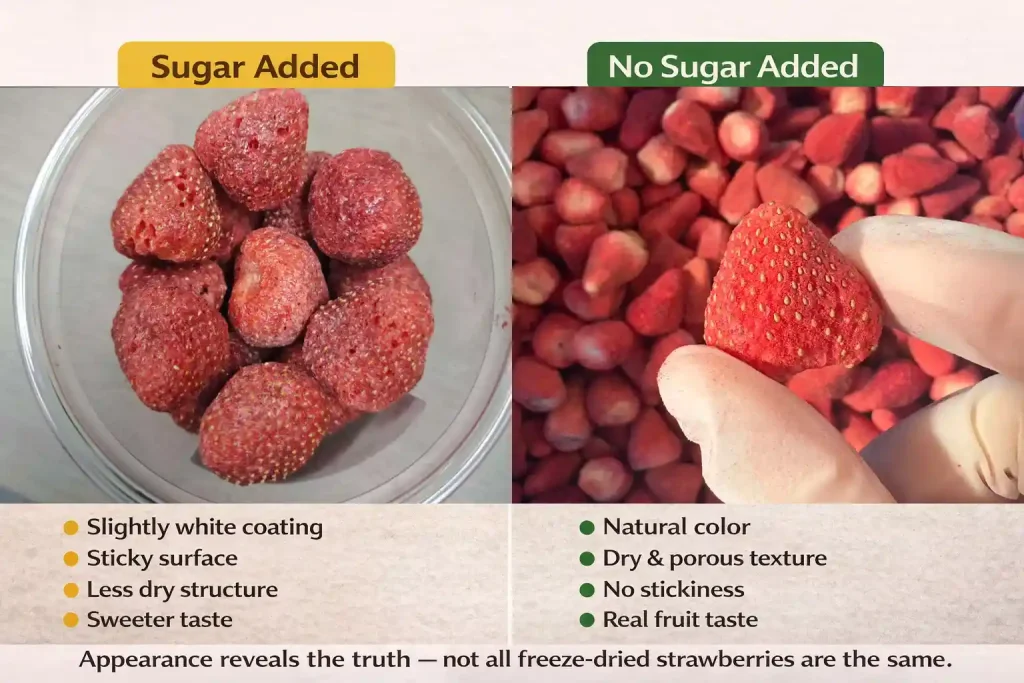
In a recent case, a Russian client carefully evaluated product quality, confirmed the absence of added sugar when evaluating no sugar freeze dried strawberries, and requested detailed packaging and logistics information. The client also planned a factory visit.
Before finalizing the order, raw material costs increased and processing costs for certain formats rose. Instead of adjusting the price immediately, we kept the original quotation for the test order.
The reason is simple. A test order is an opportunity to build trust. Long-term cooperation is more important than short-term price adjustments.
What reliable suppliers should do
A reliable supplier should not avoid discussing price changes. Instead, they should explain them clearly and consistently.
Buyers should expect transparency, logical pricing, and a focus on long-term cooperation rather than short-term profit.
FAQ for Buyers
Why do freeze-dried strawberry prices change?
Prices change mainly due to raw material fluctuation, processing complexity, and order structure. Strawberries are agricultural products, so their cost varies depending on season, supply, and quality level.
Are price changes a sign of an unreliable supplier?
Not necessarily. Price changes are normal in this industry. What matters is whether the supplier can clearly explain the reason and maintain consistent pricing logic.
Why are slices and dices sometimes more expensive than whole strawberries?
Slices and dices require additional cutting and often more careful raw material selection. They also have different drying parameters, which increases production complexity and cost.
Can different formats be produced together to reduce cost?
No. Whole strawberries, slices, and dices require different drying conditions and cannot be processed in the same freeze-drying cycle. This is a technical limitation.
Why are small orders more expensive per kilogram?
Small orders, especially those with multiple formats, are less efficient to produce. They often rely on existing stock or fragmented production batches, which increases unit cost.
How can buyers reduce price fluctuation risk?
Buyers can reduce risk by confirming product specifications early, increasing order volume when possible, understanding seasonal raw material changes, and working with suppliers who provide transparent explanations.
What is the best way to evaluate a supplier beyond price?
The best way is to evaluate how the supplier explains pricing, how consistent their product is, and how they handle test orders. A reliable supplier focuses on long-term cooperation, not just one transaction.
Conclusion
Price changes in freeze-dried strawberries are not random. They are driven by real factors such as raw material supply, production complexity, and order structure.
The key for buyers is not to avoid price changes entirely, but to work with suppliers who can explain them clearly and manage them professionally.
In the end, choosing the right supplier means choosing a stable and reliable supply system, not just a price. If you are evaluating suppliers, you can request samples or contact a trusted freeze dried fruit supplier to start your test order.