
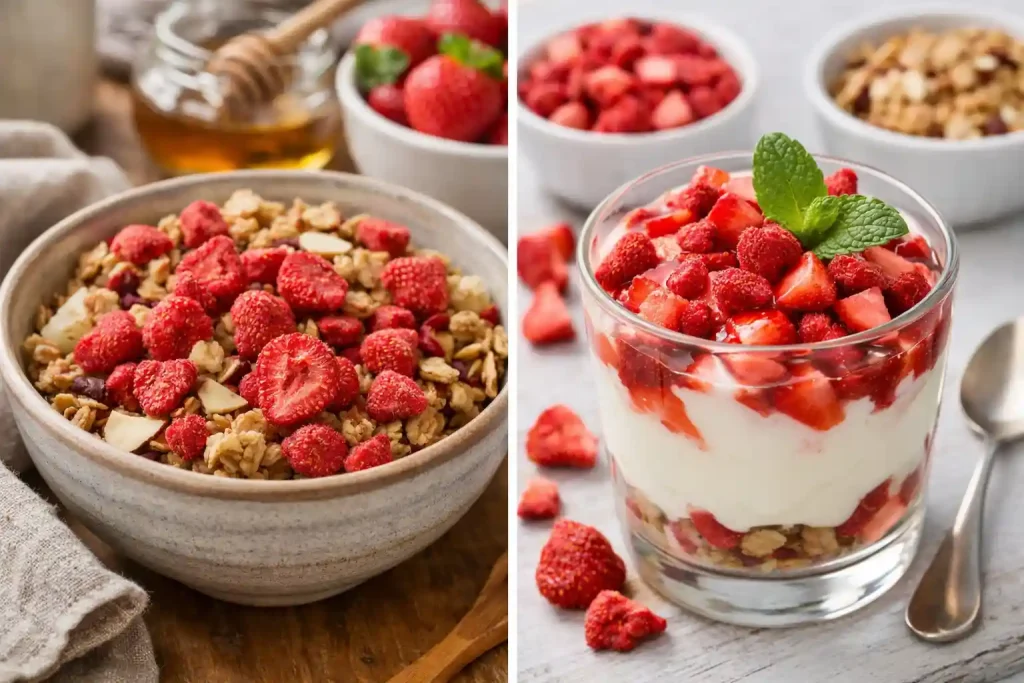
For most granola brands, we usually recommend using 5%–10% slightly sugar-added freeze-dried strawberries instead of completely no-sugar versions.
This is not just a general suggestion. It comes from real customer experience and what actually happens after products go into testing and the market.
Why This Recommendation Matters
Recently, one of our customers from Ukraine was sourcing freeze-dried strawberries for granola production.
At the beginning, he was unsure whether to choose sugar-added or no-sugar products. We offered both options, which is quite common in B2B sourcing. Most buyers face the same question at the early stage.
At that point, the decision is not really about price. It is about whether the product will actually work well in the final application.
What Most Buyers Think at the Beginning
Most customers initially prefer no-sugar freeze-dried strawberries.
The reason is quite straightforward. No-sugar products are often seen as more natural, they fit better with clean label positioning, and they seem closer to the original fruit.
We fully understand and respect this choice.
In many cases, buyers are not planning to sell the strawberries directly as a snack. They see them as an ingredient that will be used in a larger product system.
What Happens After They Receive the Product
However, things often change after the product arrives and testing begins.
We see many customers start doing secondary processing, such as coating the strawberries with chocolate, combining them with yogurt, or mixing them into sweet snack systems like granola and cereal.
The reason is simple. They are trying to turn the ingredient into a product that consumers can enjoy directly.
The challenge is that no-sugar freeze-dried strawberries, although natural, tend to taste quite sour when eaten on their own. This is especially noticeable in products like granola, where the fruit is expected to balance the overall flavor instead of standing out as too sharp.
Because of this, many buyers end up adjusting their formulation to improve taste.
What This Means in Practice
In real market situations, if the strawberries are not sweet enough, different things can happen.
Some consumers will add sugar themselves. Some brands will only use the product as a minor mix-in. In some cases, the product simply does not perform well in repeat sales.
This is why the initial product choice needs to match how the final product is positioned.
Sugar-Added Freeze-Dried Strawberries in Real Use
We also supply sugar-added freeze-dried strawberries, and this option is quite popular among our customers in Europe and Southeast Asia.
The sugar level is typically between 5% and 10%, and it can be adjusted depending on the application. We use standard white granulated sugar rather than artificial sweeteners.
There are two main reasons why a small amount of sugar is added.
The first is to balance the natural sourness of strawberries. After freeze-drying, the acidity becomes more noticeable, and a small amount of sugar helps create a more balanced taste.
The second reason is related to product stability. Freeze-dried strawberries are light and fragile. Without any sugar, they tend to break more easily and generate powder during handling and transportation. A slight sugar addition helps reduce this problem and makes the product more stable in bulk use.
Why Buyers Are Careful About Sugar
Many buyers are cautious when it comes to sugar-added products. On the surface, it may seem like a concern about health, but in practice it is more about control.
They are thinking about labeling, product positioning, consistency, and whether the supplier is reliable.
For example, in some markets, claims like “no added sugar” are important for sales. Once sugar is added, the labeling has to change, and that can affect how the product is positioned.
There is also a trust factor. Buyers want to be sure that what is declared is accurate, and that there are no unexpected ingredients.
From a brand perspective, especially for products like granola or health snacks, added sugar can influence how consumers perceive the product.
Finally, there is the question of performance. Buyers want to know whether the product will behave consistently in mixing, storage, and final consumption.
So the real question is not simply whether there is sugar or not. It is whether the product will create any problems later.
A Practical Comparison
When comparing no-sugar and slightly sugar-added freeze-dried strawberries, the differences are quite clear in real use.
No-sugar products are better suited for clean label positioning and strict health-oriented concepts. However, they tend to be more sour and more fragile, which can lead to powdering.
Slightly sugar-added products offer a more balanced taste and are easier to use in products that are consumed directly. They are also more stable during handling. The trade-off is that labeling needs to reflect the added sugar.
Our Recommendation Based on Application
For granola and similar products that are eaten directly, we usually suggest trying the slightly sugar-added version first. It tends to deliver a better overall eating experience.
For products that require strict health positioning or specific labeling, no-sugar options are still the right choice.
If you are not sure which direction to take, the most practical approach is to test both versions side by side and evaluate them based on your own product and market.
Is Sugar-Added Freeze-Dried Strawberry Unhealthy
From a food science perspective, adding a small amount of sugar at the level of 5% to 10% does not introduce any unusual safety risks.
What changes is mainly the total sugar content and the calorie level. There is also a slight reduction in nutritional density per unit weight.
However, in B2B applications, the more important consideration is usually not health impact, but how the product fits into your labeling strategy and market positioning.
In other words, the risk is not about safety, but about whether the product aligns with your brand and target market.
Why Sugar Is Viewed Differently in Snacks and Ingredients
You may notice that consumers readily accept chocolate-coated or yogurt-coated freeze-dried strawberries, even though these products also contain sugar.
The difference lies in how the product is positioned.
When strawberries are part of a finished snack, sweetness is expected. When they are used as an ingredient, buyers need more control over the formulation.
This is why sugar becomes a more sensitive topic in B2B sourcing.
Product Specifications and Options
We offer different formats depending on how the product will be used, including whole strawberries, slices, and dices in various sizes.
The sugar level can be adjusted between 5% and 10% based on requirements.
Packaging options are available for bulk supply, typically 5 kg cartons for whole and sliced products, and 10 kg cartons for powder.
How to Start Your Testing
If you are working on a granola or cereal product, a simple approach is usually the most effective.
First, confirm how the strawberries will be used in your product. Then select both no-sugar and slightly sugar-added versions for comparison.
After that, conduct testing under your actual production or formulation conditions, and make your decision based on real performance rather than assumptions.
Final Thought
Choosing the right freeze-dried strawberry is not just about finding the lowest price.
It is about making sure the product fits your application, performs consistently, and meets your consumers’ expectations.
If you want to move forward, the best next step is to test both versions and see the difference in your own product.